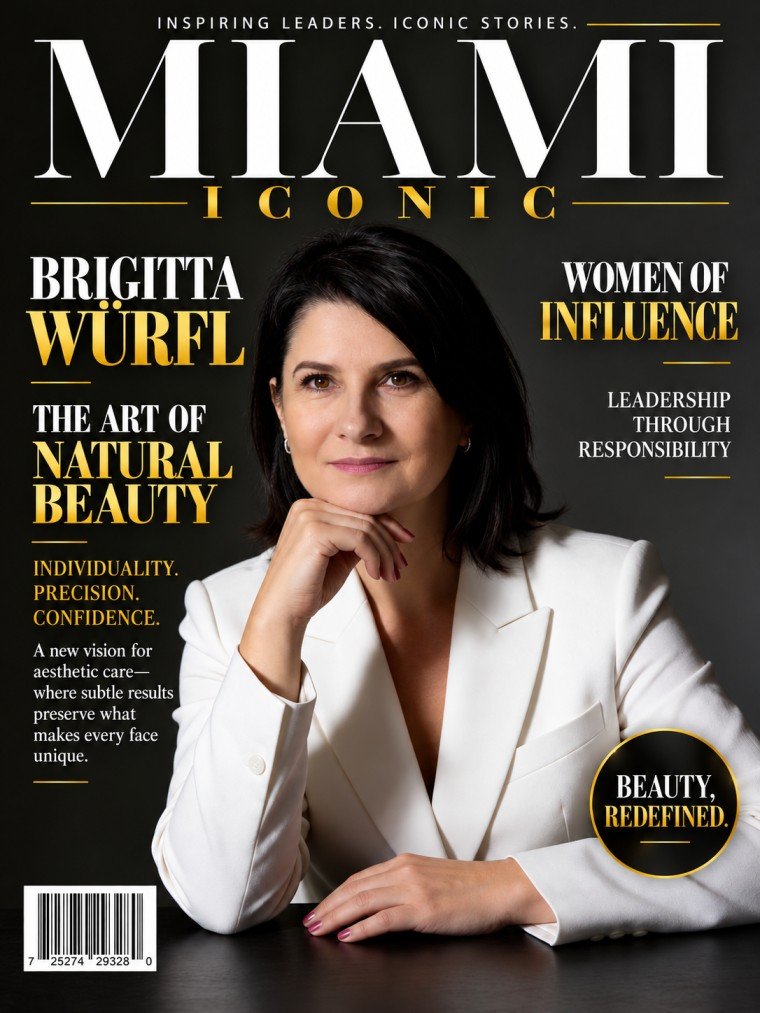
The aesthetics industry is entering an era in which transformation is no longer defined by how much can be changed but by how thoughtfully change is approached. As technology and treatment techniques continue to advance, a growing number of people are choosing results that appear effortless—enhancements that restore freshness, support skin quality, and preserve the characteristics that make a person unmistakably themselves.
This changing perspective has created space for a more individualized philosophy of aesthetic care. For Brigitta Würfl, founder of Skin Aesthetics Atelier, beauty has never been about reproducing a particular look. Her work centers on recognizing the individuality of every face and creating an approach that respects its natural structure, personality, and expression.
Her philosophy is built on a simple but powerful idea: aesthetic medicine should complement identity rather than replace it.
Moving Beyond a Single Definition of Beauty
Beauty has traditionally been influenced by changing ideals, celebrity culture, and increasingly, social media. Certain facial proportions, lip shapes, contours, and features can quickly become fashionable, creating the impression that there is one correct way to look.
Würfl takes a different view.
She believes contemporary aesthetics should give people greater freedom to define beauty on their own terms. A successful treatment does not need to make a person look dramatically different. Instead, it can help them appear rested, refreshed, healthy, and confident while retaining the characteristics that make their appearance personal.
Every face carries its own architecture. Bone structure, proportions, movement, expressions, skin condition, and individual character all contribute to how someone looks. Because of this, there can be no universal treatment formula that works equally well for everyone.
For Würfl, understanding what should remain unchanged can be just as important as identifying what might benefit from treatment.
When Less Can Achieve More
Subtle aesthetic work demands a particularly high level of judgment. A noticeable transformation can be easy to recognize, but creating a result that feels completely natural requires a much more delicate understanding of proportion and balance.
Even a small adjustment can influence the relationship between different facial features. Anatomy, symmetry, movement, skin quality, and overall facial harmony all have to be considered before deciding on an approach.
This is why restraint plays such an important role in Würfl’s philosophy.
Rather than automatically treating every area that could be altered, she believes practitioners should carefully determine whether intervention is actually necessary. The goal is not to maximize treatment. It is to achieve the right treatment for the right individual.
The ideal outcome may be surprisingly understated: someone appears more rested and vibrant, yet their friends and family cannot immediately determine what has changed.
That kind of subtlety is not accidental. It is the result of precision.
Personal Treatment Starts With Personal Understanding
No two patients bring exactly the same needs to an aesthetic practice. Even when two people are concerned about a similar feature, their anatomy, lifestyle, skin condition, treatment history, expectations, and personal goals may be entirely different.
This makes consultation an essential part of Würfl’s approach.
Before developing a treatment strategy, understanding the person behind the concern matters. What would they like to improve? What do they want to preserve? What outcome would make them feel more comfortable and confident?
These questions can completely change the direction of treatment planning.
Personalization also means recognizing when treatment is unnecessary. A responsible practitioner must be comfortable explaining when a procedure is unlikely to provide meaningful benefit or when a patient’s concern may be better addressed through another approach.
For Würfl, patient trust depends on transparency. Aesthetic care should be based on realistic expectations, informed decisions, and a genuine commitment to the individual’s well-being.
Resisting the Social Media Template
Digital platforms have dramatically changed the way people discover aesthetic treatments. Patients today have access to more information, examples, and treatment discussions than ever before.
Yet greater visibility can also create pressure.
When the same aesthetic features appear repeatedly online, they can begin to feel like universal standards. Faces become compared with faces, and individuality can gradually be replaced by imitation.
Würfl believes aesthetic medicine should challenge that tendency rather than reinforce it.
A patient’s face should not be treated as a blank canvas for recreating an influencer, celebrity, or online trend. Instead, treatments should work with the individual’s existing anatomy and preserve the qualities that give their appearance character.
In an increasingly digital world, authenticity may be one of the most valuable forms of beauty.
From Correction to Skin Quality
The evolution of aesthetics is also changing the way practitioners think about aging. Instead of focusing exclusively on correcting visible signs, there is growing interest in maintaining and supporting the overall quality of the skin.
This is where regenerative aesthetics has become an increasingly important area of discussion.
Approaches such as platelet-rich plasma, commonly known as PRP, use components obtained from a patient’s own blood and naturally occurring growth factors. Such treatments are associated with efforts to support tissue processes and collagen production.
For Würfl, the significance of regenerative aesthetics goes beyond a particular procedure. It represents a broader shift toward considering the biological health and quality of the skin rather than simply attempting to disguise signs of aging.
A long-term aesthetic strategy can incorporate skincare, prevention, skin-quality treatments, regenerative approaches, and selective procedures according to an individual’s needs.
The goal is not to fight every sign of time. It is to help people maintain healthy, vibrant-looking skin as they move through different chapters of their lives.
Sharing Knowledge Beyond the Treatment Room
Würfl’s professional influence extends into education, where she actively contributes to conversations surrounding contemporary aesthetic practice.
Her participation as a speaker at BEAUTY FORUM Day in Stuttgart provided an opportunity to exchange knowledge with fellow professionals. During the event, she led a workshop centered on collagen stimulators, exploring modern approaches that place greater emphasis on skin quality and biological processes.
For Würfl, teaching is not simply about demonstrating a technique. Meaningful professional education requires practitioners to understand why a treatment works, who may benefit from it, where its limitations lie, and how it should be incorporated responsibly into patient care.
The interaction with other professionals is equally valuable. Questions, different perspectives, and shared experiences can deepen understanding and encourage practitioners to continue examining their own methods.
Her participation reflects a belief that progress within aesthetic medicine depends on an ongoing exchange of knowledge.
Staying Ahead Without Chasing Every Trend
Aesthetic medicine is developing at remarkable speed. New devices, products, procedures, and treatment philosophies appear regularly, often accompanied by significant attention online.
But innovation and popularity are not necessarily the same thing.
Würfl believes new treatments should be approached with curiosity as well as caution. Practitioners need to consider available evidence, safety, appropriate indications, limitations, potential complications, and whether a particular treatment genuinely serves the patient’s interests.
This ability to evaluate new developments critically is becoming increasingly important.
Continuing education therefore involves more than learning the latest technique. It requires a strong foundation in anatomy, patient assessment, safety, ethics, treatment selection, and realistic outcomes.
Remaining current means being willing to learn—but also being willing to question.
Leadership Through Responsibility
For Würfl, professional recognition is meaningful when it creates opportunities to contribute something beyond personal visibility.
Leadership can take many forms. It can involve educating peers, encouraging higher standards, discussing emerging developments, sharing professional experience, and helping patients approach aesthetic medicine with greater understanding.
This perspective gives influence a deeper purpose.
Rather than defining success solely through visibility or recognition, Würfl’s work reflects an emphasis on knowledge, responsible decision-making, and patient-centered care.
Her message is particularly relevant in an industry where trends can move faster than thoughtful evaluation. True influence can mean helping others make better-informed choices.
A More Authentic Future for Aesthetics
The next chapter of aesthetic medicine may be less about achieving a predetermined appearance and more about developing individualized strategies that respect who people already are.
As patients become more educated, many are seeking treatments that support their appearance without dramatically altering their identity. This could lead to greater integration of personalized skincare, preventative care, regenerative approaches, treatments focused on skin quality, and carefully selected aesthetic procedures.
The future, in Würfl’s view, belongs to personalization.
Beauty does not have to remain frozen at one age or conform to one aesthetic standard. It can change naturally over time while still allowing people to feel confident in their appearance.
The Most Refined Result May Be the Least Obvious
Brigitta Würfl’s philosophy ultimately returns to a fundamental principle: aesthetic medicine should help people feel more comfortable in their own skin rather than make them feel disconnected from it.
The strongest result is not always the one that produces the biggest visual difference. It may be the subtle improvement that makes someone feel refreshed, balanced, and confident while leaving their identity completely intact.
That philosophy places precision above excess and individuality above imitation.
In an era when social media can make beauty feel increasingly standardized, Würfl’s approach offers a compelling alternative. The future of aesthetics does not have to be about looking like someone else. It can be about preserving what is already distinctive, improving what genuinely needs attention, and embracing beauty as something personal and constantly evolving.
Perhaps the ultimate measure of sophisticated aesthetic care is remarkably simple: the person still looks like themselves—only refreshed, confident, healthy, and comfortable in the way they see their own reflection.

Leave a Reply