
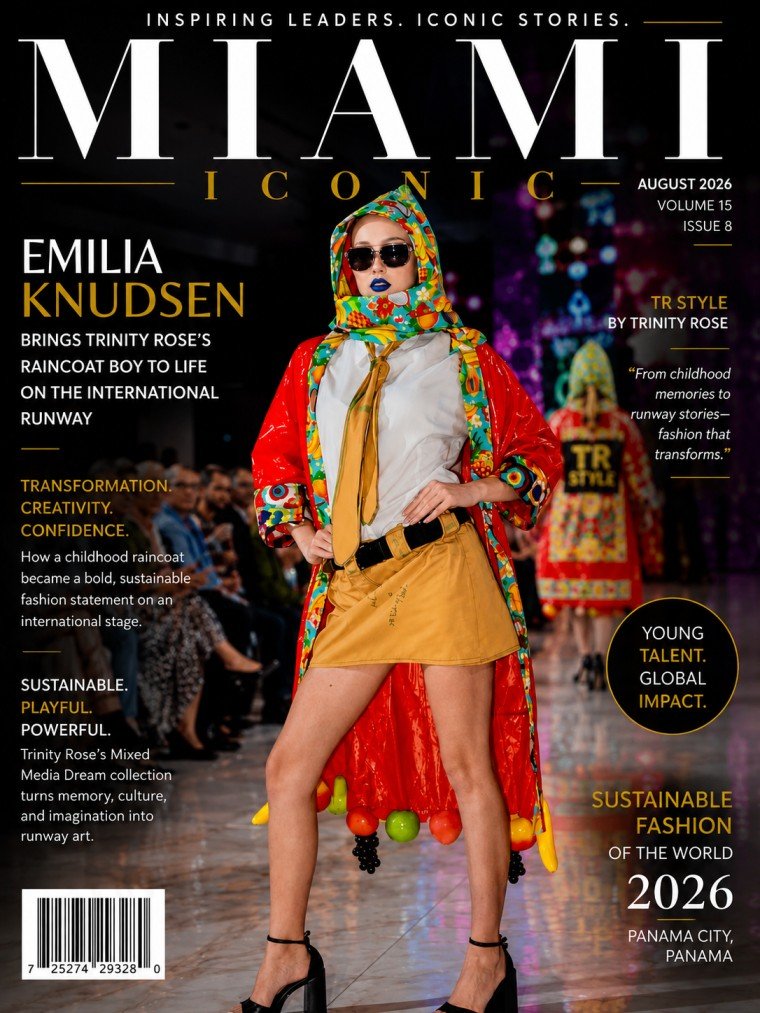
At Sustainable Fashion of the World 2026 in Panama City, Panama, Emilia Knudsen became the face of one of the most distinctive looks presented on the international runway. Wearing Raincoat Boy from Barbadian designer Trinity Rose’s TR Style collection, Knudsen transformed an unconventional sustainable fashion piece into a memorable runway character.
At 18, Knudsen brought a youthful yet assured presence to the design, allowing its unusual details to stand out without overshadowing the story behind them. The result was a runway presentation that combined confidence, individuality, cultural nostalgia, and contemporary fashion.


Raincoat Boy is part of Trinity Rose’s Mixed Media Dream collection, produced by TRIZON Productions. Built around the idea of transforming familiar materials into expressive fashion, the piece began with a childhood raincoat Rose wore when she was around eight years old. For Knudsen, that childhood memory took on a completely new identity, becoming an expressive statement on an international stage.
The oversized red raincoat immediately creates a strong silhouette around Knudsen. Its dramatic proportions give her appearance a theatrical quality, while colorful fruit-print fabric across the hood, borders, and pockets adds another layer of personality. But it is the three-dimensional fruit attached to the lower hem that makes the look particularly unexpected.
Plastic bananas, grapes, peaches, mangoes, pomegranates, and other decorative fruit move with Knudsen as she walks. Rather than functioning simply as decoration, these elements connect the garment to memories of Caribbean homes during the 1970s and 1980s, when artificial fruit, flowers, and plants were commonly used as household décor.
Knudsen’s role is particularly important because the garment demands more than simply wearing an unusual outfit. Its theatrical construction could easily become a novelty if presented without confidence. Instead, Knudsen’s controlled runway presence gives the design purpose. Her posture, movement, and attitude allow the exaggerated elements to become part of a complete character.
Beneath the raincoat, the styling introduces a school-uniform influence through a white button-up shirt, khaki skirt, and tie. The pieces themselves carry another layer of meaning. The skirt and tie began as practice garments and retained markings such as “Pattern Skirt 3” and “Tye 1.” Rather than hiding those details, the designer incorporated them into the finished look.
For Knudsen, wearing a design built around experimentation and learning creates a natural connection between the garment and the idea of personal development. The school-inspired styling represents a period of discovery, while the transformed raincoat represents growth beyond childhood.
The large TR Style treatment across the back completes the visual statement, making it clear that what might initially appear to be a familiar raincoat has been transformed into a distinctive designer creation.
Knudsen’s runway appearance also demonstrates how fashion presentation can influence the way audiences experience sustainable design. The garment is not static. As she moves, the artificial fruit swings from the hem, the oversized raincoat creates movement, and the contrasting textures become more visible. Her performance gives every component a sense of life.
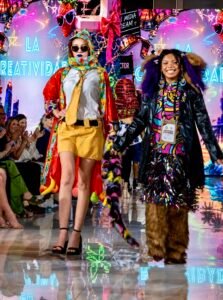
The photograph of Knudsen on the runway captures this quality particularly well. With another model appearing behind her, the presentation feels less like a conventional fashion walk and more like an unfolding story. Knudsen appears as the central character within the imaginative world created by TR Style.
Her presence also highlights the broader message behind the collection. Sustainable fashion is often associated with restraint, but Raincoat Boy takes a completely different approach. It demonstrates that reusing materials can result in something bold, playful, theatrical, and visually ambitious.

The connection between Emilia Knudsen and the garment becomes especially compelling because Raincoat Boy is fundamentally about transformation. A childhood garment has been transformed into runway art, practice pieces have become finished fashion, and familiar household objects have been reimagined as sculptural details. Knudsen completes that transformation by turning the finished design into a living runway statement.
Her appearance at Sustainable Fashion of the World 2026 places her within a broader conversation about young talent, creative expression, and the future of sustainable fashion. By carrying such an unconventional design onto an international runway, Knudsen demonstrates that strong fashion presentation is not only about the clothing itself. It is also about the confidence, character, and interpretation of the person wearing it.
Through her presentation of Raincoat Boy, Emilia Knudsen showed how a model can become an essential part of a designer’s creative vision. She did not simply showcase the garment; she gave it movement, personality, and presence.
On the Panama City runway, a childhood raincoat became something far more ambitious—and Emilia Knudsen became the person who brought that transformation to life.


Leave a Reply Cancel reply