
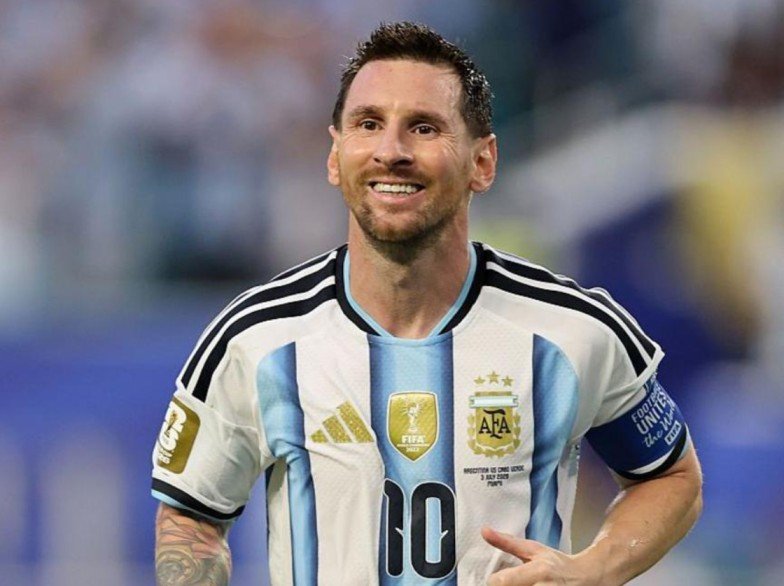
Few footballers have changed the way the sport is understood quite like Lionel Messi. His career has been defined not simply by goals, trophies, and records, but by an extraordinary ability to make the most difficult moments on a football pitch appear almost effortless. With exceptional vision, close control, creativity, and an instinctive understanding of space, Messi has built a legacy that extends far beyond statistics.
Born on June 24, 1987, in Rosario, Argentina, Messi developed a passion for football from an early age. As a child, his natural ability quickly became apparent, but his journey was not without obstacles. At a young age, he was diagnosed with a growth hormone deficiency, creating a significant challenge for his family. His talent eventually brought him to FC Barcelona, where the club played an important role in supporting his development and helping him pursue his ambitions.
Messi progressed through Barcelona’s youth system before making his senior debut as a teenager. What followed was the emergence of one of the most influential players in modern football. Rather than relying on physical strength, Messi developed a distinctive style built around acceleration, balance, precision, and intelligence. His ability to change direction while maintaining control of the ball became one of his defining characteristics.
At Barcelona, Messi transformed from a promising young player into the centerpiece of one of football’s most successful eras. He became a prolific scorer while simultaneously functioning as a creator, frequently assisting teammates and influencing the game from deeper positions. His understanding with fellow Barcelona players helped produce memorable attacking football and a remarkable collection of domestic and international honors.
Individual recognition followed. Messi won numerous Ballon d’Or awards and repeatedly demonstrated his ability to perform at the highest level over an extended period. Yet his greatness cannot be measured only through individual prizes. His consistency became perhaps his most remarkable achievement. Season after season, he continued to create opportunities, score decisive goals, and provide moments that captured the imagination of supporters around the world.
His relationship with Argentina’s national team added another important chapter to his story. For years, Messi carried enormous expectations whenever he represented his country. Reaching major finals without winning an international trophy created intense pressure, with critics questioning whether his club success could be matched on the international stage.
Messi eventually answered those doubts in the most emphatic way possible. His success with Argentina, including victory at the Copa América and the 2022 FIFA World Cup, completed a chapter that had remained unfinished for much of his career. The World Cup triumph in Qatar was particularly significant because Messi played a central role throughout the tournament and guided Argentina to the title after a dramatic final.
The victory represented more than another trophy. It became a defining moment in Messi’s relationship with Argentine football supporters. The player who had spent years carrying the expectations of an entire nation finally lifted the sport’s most prestigious international trophy. His journey demonstrated that even a career filled with extraordinary achievements could still contain unfinished ambitions.
After his historic Barcelona career, Messi entered a new phase in European football with Paris Saint-Germain before eventually moving to Inter Miami. His arrival in Major League Soccer created enormous global attention and brought a new level of visibility to football in the United States. Beyond his performances on the field, his presence contributed to wider interest in the league and the sport across the country.
What makes Messi particularly distinctive is the contrast between his enormous influence and his relatively understated personality. He has generally allowed his football to speak for him. Instead of building his reputation through controversy or theatrical behavior, he has relied on performances, discipline, and an extraordinary ability to deliver when the stakes are highest.
Messi’s influence also reaches beyond the pitch. For aspiring footballers, his career represents the importance of patience, technical development, adaptability, and perseverance. His story demonstrates that physical limitations or difficult beginnings do not necessarily determine the limits of a person’s future. Talent can open a door, but sustained excellence requires dedication over many years.
The debate over the greatest footballer of all time will continue for generations. Different eras produced different legends, and comparisons across decades are inherently difficult. However, Messi’s combination of creativity, scoring ability, playmaking, longevity, trophies, and international success places him among the most extraordinary athletes the sport has ever produced.
His legacy ultimately rests on something deeper than numbers. Messi changed the visual language of football. He showed how intelligence could overcome size, how simplicity could become spectacular, and how a player could influence an entire match through seemingly small movements and decisions.
From the streets of Rosario to the world’s biggest stadiums, Lionel Messi’s journey has become one of football’s defining stories. His career is a reminder that greatness is not created by a single performance or a single trophy. It is built through years of persistence, evolution, pressure, failure, resilience, and the courage to keep pursuing the highest possible standard.
For millions of fans, Messi is more than a football star. He represents a generation of football at its most creative—and his influence on the beautiful game is likely to remain long after his final match.


Leave a Reply Cancel reply