
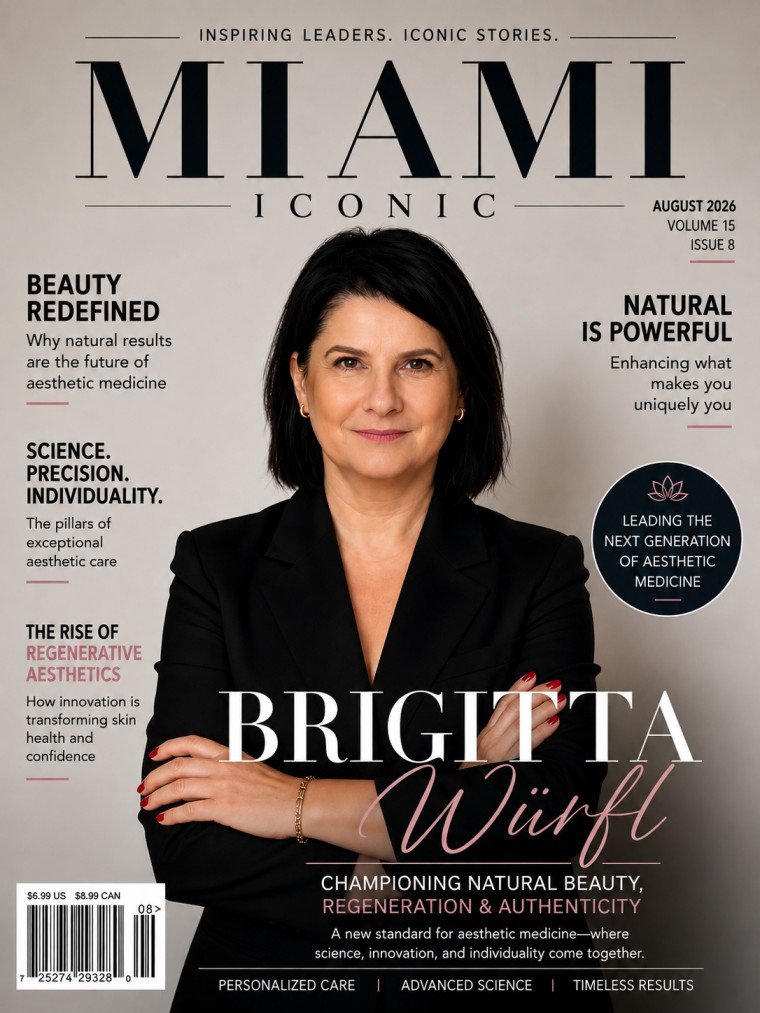
For years, the beauty industry has been fascinated by transformation. Social media feeds, advertising campaigns, and celebrity culture have often celebrated highly defined features, dramatic changes, and instantly noticeable cosmetic results. But a quieter shift is now taking place. Increasingly, patients are looking for something different: treatments that refresh rather than reconstruct, improve rather than exaggerate, and enhance individuality rather than replace it.
This changing attitude is reflected in the philosophy of German aesthetic expert Brigitta Würfl, founder of Skin Aesthetics Atelier. Her approach represents a growing movement within modern aesthetic medicine that places natural results, scientific understanding, regenerative techniques, and personalized treatment at the forefront.
The emerging question is no longer simply, How much can aesthetic medicine change? Instead, it is becoming: How can aesthetic medicine help people look and feel their best while still looking like themselves?
Moving Beyond the Culture of Extreme Transformation
The definition of an attractive appearance has never remained static. Yet the influence of digital media has accelerated beauty trends to an unprecedented level. Certain facial proportions, contours, and cosmetic effects can quickly become popular, creating pressure to reproduce a particular appearance.
Würfl’s philosophy challenges this standardized approach.
Rather than treating individuality as something that needs correction, her methodology begins with the belief that each face already contains its own balance and character. Aesthetic treatment should therefore work with those existing qualities.
The most effective outcome may be surprisingly subtle. A patient might simply appear more rested, refreshed, or radiant. Friends and colleagues may notice that something looks different without being able to identify exactly what has changed.
That discretion is not a limitation. It is the objective.
Natural-looking aesthetics requires restraint, precision, and an understanding that more treatment does not necessarily mean better treatment.
Science Behind the Subtlety
Achieving an understated result can be considerably more complex than creating an obvious one.
Aesthetic medicine combines medical knowledge with an understanding of proportion, symmetry, movement, skin condition, and facial anatomy. Small changes can influence the appearance of an entire face, making careful assessment essential.
For Würfl, scientific knowledge forms the foundation of responsible aesthetic practice. Understanding the structure of the face and the biology of the skin helps practitioners determine not only what can be treated, but also what should be left untouched.
This distinction is particularly important in an industry where technological developments are advancing rapidly.
New procedures, products, and techniques continue to enter the market, but innovation alone does not guarantee quality. Effective aesthetic care requires practitioners to understand the evidence behind treatments, recognize individual differences, and continually update their knowledge.
The combination of medical expertise and aesthetic judgment is what allows subtle improvements to appear natural rather than artificial.
There Is No Universal Formula for Beauty
One of the biggest misconceptions surrounding aesthetic treatments is the idea that the same procedure can deliver the same result for everyone.
In reality, every face tells a different story.
Facial proportions, skin quality, expressions, age, lifestyle, previous treatments, and personal expectations all influence the appropriate approach. Even two people with the same cosmetic concern may require completely different treatment strategies.
This makes personalization central to Würfl’s philosophy.
A meaningful aesthetic plan begins with listening and observation. Understanding what a patient wants is just as important as evaluating their physical features. The goal is not to impose an external beauty standard, but to develop a strategy that respects the person’s existing appearance.
This patient-specific approach can also help prevent unnecessary treatments. Instead of treating every visible feature, the focus remains on identifying where carefully chosen interventions can create the greatest overall improvement.
Regenerative Medicine Changes the Conversation
Another major development reshaping aesthetic medicine is the increasing interest in regenerative approaches.
Traditional cosmetic treatments have often focused on correcting or disguising visible signs of aging. Regenerative medicine approaches the subject from another direction, emphasizing the body’s natural biological processes and the quality of the tissue itself.
PRP therapy is one example that has attracted significant interest. Using components obtained from a patient’s own blood, PRP treatments are designed to utilize naturally occurring growth factors and support processes associated with tissue repair and collagen production.
The appeal of regenerative approaches fits naturally with the growing preference for subtle results. Rather than pursuing an immediate and dramatic visual change, these treatments can be incorporated into strategies focused on gradual improvement and healthier-looking skin.
For Würfl, this represents more than another addition to the aesthetic treatment menu. It signals a broader change in philosophy—from simply covering the effects of aging to supporting the skin’s own regenerative potential.
From Instant Results to Long-Term Skin Health
The beauty conversation is also moving away from the obsession with instant results.
Patients are becoming increasingly interested in the condition and quality of their skin rather than focusing exclusively on individual lines, contours, or facial features. This has created greater interest in approaches that consider long-term skin health as part of aesthetic care.
Regenerative treatments, personalized skincare strategies, and preventative approaches all fit within this wider movement.
The objective is not necessarily to stop the natural aging process. Instead, it is to help individuals age in a way that maintains vitality and confidence.
This distinction changes the relationship between patient and practitioner. Aesthetic medicine becomes less about correcting perceived flaws and more about developing a long-term strategy for maintaining appearance and well-being.
Education Is Becoming Part of Responsible Aesthetics
As the industry expands, the importance of professional education is becoming increasingly apparent.
Advanced treatments require more than familiarity with equipment or procedures. Practitioners need a detailed understanding of anatomy, treatment limitations, potential risks, patient selection, and ethical considerations.
Würfl has extended her professional work into education through workshops, training programs, and international speaking engagements. Her emphasis on knowledge-sharing reflects the belief that raising standards across the profession ultimately benefits patients.
This is particularly relevant in an industry where new techniques can become popular rapidly through social media before sufficient understanding of their long-term applications has developed.
Education provides a counterbalance to trends.
It encourages practitioners to evaluate treatments through scientific evidence and professional judgment rather than simply following what happens to be popular.
Recognition Should Serve a Bigger Purpose
International recognition can bring visibility to an aesthetic professional, but the significance of such recognition extends beyond personal achievement.
For Würfl, professional acknowledgment provides an opportunity to draw attention to the principles she believes should define modern aesthetic medicine: responsible practice, scientific knowledge, patient safety, and individualized care.
Awards and professional milestones become more meaningful when they help encourage better standards throughout the field.
This perspective reflects an important change in the way leadership within aesthetics can be understood. Influence is not solely about popularity or visibility. It can also come from educating others, promoting responsible practices, and encouraging a more considered approach to beauty.
Aesthetic Medicine Is Becoming More Personal
The future of aesthetics may ultimately be less about following trends and more about understanding individuality.
Patients are increasingly asking for results that do not dramatically change their appearance. They want to retain recognizable features while addressing concerns that affect their confidence.
This preference is pushing the industry toward more sophisticated treatment planning.
Personalized strategies, regenerative medicine, advanced anatomical knowledge, and an emphasis on skin health are likely to play an increasingly important role as aesthetic medicine develops.
The result could be a beauty culture that is considerably less focused on perfection and more interested in authenticity.
Redefining What a Successful Treatment Looks Like
The most important transformation in modern aesthetics may not be technological at all. It may be the changing definition of success.
A successful treatment does not necessarily need to produce a dramatic before-and-after photograph. Sometimes the strongest outcome is one that preserves the patient’s identity while subtly improving how they look and feel.
That philosophy lies at the center of Brigitta Würfl’s approach.
Through her work at Skin Aesthetics Atelier and her wider contribution to professional education, she represents an emerging model of aesthetic medicine built around precision rather than excess, regeneration rather than concealment, and individuality rather than imitation.
The future of beauty may therefore belong not to those who seek to look completely different, but to those who want to look unmistakably themselves—only healthier, more refreshed, and more confident.
In that sense, the next generation of aesthetic medicine is not about changing the face. It is about changing the way we think about beauty itself.


Leave a Reply Cancel reply