
Every major era of technology has been shaped by innovators willing to challenge established assumptions. From the invention of the transistor to the rise of artificial intelligence, transformative progress has often emerged when researchers and entrepreneurs looked beyond the limitations of existing systems.
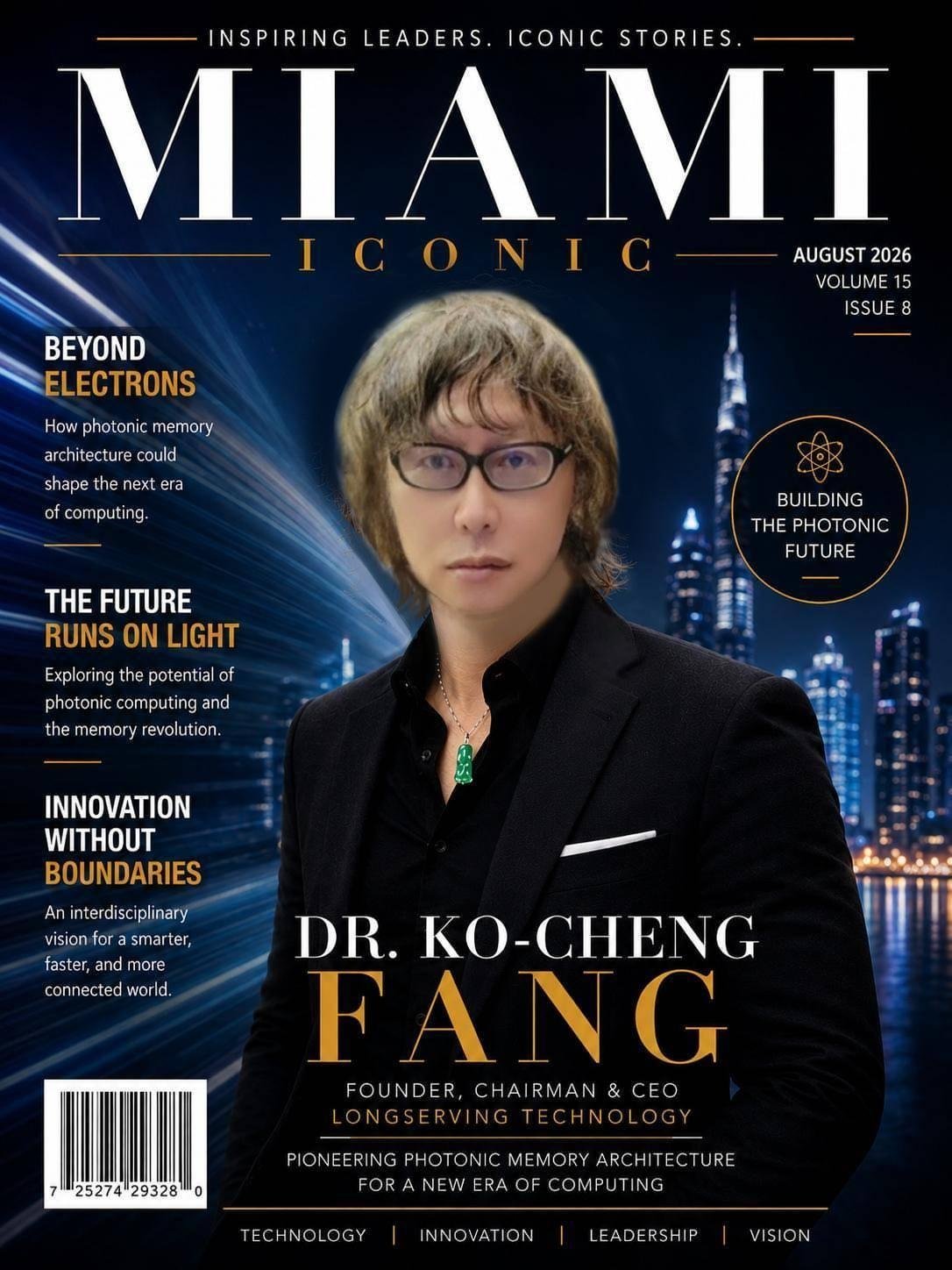
In 2026, Dr. Ko-Cheng Fang is pursuing one of the most intriguing possibilities for the future of computing: using light to overcome some of the limitations of conventional electronic systems.
As Founder, Chairman, and CEO of LongServing Technology, Dr. Fang is exploring an ambitious vision centered on photonic memory architecture—an approach that could influence how future computing systems store, move, and process information.
For decades, silicon-based electronics have been the foundation of the digital age. Smartphones, data centers, supercomputers, and AI systems all depend on increasingly sophisticated semiconductor architectures containing billions of microscopic transistors.
Yet the rapid development of artificial intelligence is creating demands that conventional computing architectures are finding increasingly difficult to accommodate. Modern AI systems must continuously move enormous quantities of information between processors and memory, creating challenges involving bandwidth, latency, energy consumption, and overall efficiency.
This has encouraged researchers worldwide to explore alternatives and complementary technologies.
Among the most promising possibilities is photonic computing, which uses light to transmit and, in some architectures, process information. Instead of depending entirely on electrical signals, photonic systems use photons to move data at extremely high speeds while potentially reducing some of the energy costs associated with conventional data movement.
It is within this rapidly developing field that Dr. Fang’s work has attracted attention.
An Interdisciplinary Approach to Innovation
Dr. Fang’s career reflects an approach to technology that extends across multiple areas of science and engineering.
His published work encompasses fields including:
- Photonic computing
- Artificial intelligence
- Cybersecurity
- Semiconductor technology
- Biotechnology
- Advanced materials
- Industrial design
- Digital infrastructure
This breadth is significant because many of the most difficult challenges facing modern computing cannot be solved by examining processors, memory, communication systems, or software independently.
Dr. Fang’s approach instead considers computing as an interconnected ecosystem. His vision explores how memory, processing, communication, and optical technologies might eventually work together within highly integrated architectures.
Why Memory Has Become a Critical Computing Challenge
Modern processors can execute enormous numbers of calculations in extremely short periods. Yet computational performance is increasingly influenced by another factor: how quickly information can reach the processor.
This challenge is commonly associated with the memory wall, describing the growing gap between processing capability and the speed at which data can be supplied to computing units.
The problem becomes particularly important in artificial intelligence. Large-scale AI models, autonomous systems, scientific simulations, and advanced analytics require constant movement of massive datasets. When processors have to wait for data, performance can decline while energy consumption increases.
Photonic memory research seeks to address part of this challenge by investigating optical methods for storing, transmitting, and managing information.
Rather than relying entirely on electrons moving through conventional electrical interconnects, optical architectures can use light-based pathways to transfer information at extremely high bandwidths. The long-term objective is to create computing environments capable of handling growing data requirements with greater speed and efficiency.
Understanding the Potential of Photonic Computing
A simple analogy helps illustrate the concept.
Imagine a traditional highway carrying an ever-growing number of vehicles. Eventually, increasing traffic creates congestion regardless of how powerful the individual vehicles become. One solution is not simply to build faster cars, but to redesign the transportation network itself.
Computing faces a similar challenge.
Processors may continue becoming more capable, but if enormous quantities of information cannot move efficiently between computing components, overall system performance remains constrained.
Photonic technology approaches the problem from a different direction by using photons to transport information.
According to technical material published by LongServing Technology, Dr. Fang’s proposed architecture explores a layered photonic design incorporating optical memory, photonic logic, and dedicated routing structures. Technical illustrations associated with the concept describe a three-layer architecture intended to improve internal data movement and reduce communication bottlenecks.
The proposed design also incorporates an optimized 45-degree optical pathway intended to direct light through the architecture more efficiently.
The technology remains under development, but the concept illustrates an important shift: photonics may have applications that extend beyond high-speed communication and become increasingly integrated with memory and computation.
A Broader Technology Philosophy
For Dr. Fang, photonics represents more than a replacement for one component of the conventional computer.
His wider body of work reflects the idea that the next generation of technology will increasingly emerge from the intersection of different disciplines.
Semiconductors, artificial intelligence, cybersecurity, biotechnology, advanced materials, and optical technologies are no longer completely isolated fields. Developments in one area can increasingly influence progress in another.
This interdisciplinary perspective is particularly relevant to future AI infrastructure, where computational power must be accompanied by faster communication, efficient memory systems, advanced materials, secure architectures, and sustainable energy use.
Through LongServing Technology, Dr. Fang is exploring how these elements might be brought together into a more integrated technological ecosystem.
Taiwan and the Next Wave of Deep Technology
Taiwan occupies a unique position in the global technology industry.
For decades, the island has been central to semiconductor manufacturing, advanced chip production, packaging, and the global electronics supply chain. Its expertise has helped power everything from consumer electronics to cloud infrastructure and AI hardware.
As traditional transistor scaling becomes increasingly challenging, however, the semiconductor industry is entering a period in which new approaches are becoming increasingly important.
Silicon photonics, advanced packaging, heterogeneous integration, optical interconnects, and alternative computing architectures are among the areas attracting growing research attention.
Within this environment, companies such as LongServing Technology represent another dimension of Taiwan’s technology ecosystem—one focused not only on manufacturing expertise but also on exploring new concepts for future computing.
The Global Shift Toward Photonic Computing
Dr. Fang’s work is part of a broader international movement.
Technology companies and research organizations around the world are investigating photonic technologies as potential solutions to the growing demands of AI and high-performance computing. Organizations including NVIDIA, Intel, IBM, Google, Lightmatter, and Ayar Labs are exploring different aspects of optical communication and computing.
Their approaches differ considerably. Some focus on optical interconnects, while others investigate photonic accelerators, optical networking, or data-center infrastructure.
Together, these developments demonstrate a growing recognition that moving information efficiently is becoming just as important as processing it.
LongServing Technology’s emphasis on photonic memory adds another perspective to this evolving field.
The eventual future of computing may not depend on a single architecture. Instead, hybrid systems combining electronic processors, photonic communication, advanced memory, and specialized accelerators could become increasingly important.
From Scientific Concept to Commercial Opportunity
The potential economic implications of more efficient computing are substantial.
Artificial intelligence has generated enormous demand for processors, memory, networking equipment, data centers, and energy infrastructure. As AI workloads continue expanding, technologies capable of improving computational efficiency could have applications across numerous industries.
If photonic memory and related technologies achieve commercial maturity, potential applications could include AI accelerators, cloud computing, data centers, robotics, autonomous systems, biotechnology, scientific computing, telecommunications, smart manufacturing, aerospace, edge computing, and digital healthcare.
However, technological promise alone does not guarantee commercial success.
Deep-tech innovations must pass through demanding stages of engineering, validation, manufacturing optimization, cost reduction, software integration, and market adoption. A research concept must ultimately demonstrate reliability, scalability, and practical value before becoming a widely deployed commercial platform.
For photonic computing, these challenges remain an important part of the journey.
The Engineering Challenges Ahead
The path toward practical photonic computing is complex.
Integrating optical components with established semiconductor manufacturing processes can be technically demanding. Engineers must also consider fabrication precision, thermal behavior, packaging, manufacturing economics, reliability, and compatibility with existing computing systems.
Another challenge involves software.
For any new computing architecture to achieve widespread adoption, developers need ways to use it without completely rebuilding the existing software ecosystem. Hardware innovation therefore needs to be accompanied by suitable programming frameworks, interfaces, development tools, and industry partnerships.
These realities make the transition from research to commercial deployment a long-term process.
The history of technology shows that influential innovations are rarely defined by a single breakthrough. They succeed when scientific discovery, engineering discipline, manufacturing capability, business strategy, and market demand come together.
Building Tomorrow’s Computing Architecture
The history of computing has always been a story of transformation.
Vacuum tubes gave way to transistors. Mainframes evolved into personal computers. Distributed infrastructure created the cloud. Smartphones placed immense computational power into the hands of billions of people. Artificial intelligence is now reshaping the architecture of computing once again.
Photonic technology represents one possible direction in that continuing evolution.
Whether photonic memory eventually becomes a fundamental component of future computers or develops as part of hybrid architectures combining optical and electronic technologies, the research surrounding it points toward a larger change in the industry’s priorities.
The question is no longer simply how to build faster processors.
It is how to create complete computing systems capable of moving, storing, and processing extraordinary quantities of information while maintaining speed, efficiency, scalability, and sustainability.
For Dr. Ko-Cheng Fang and LongServing Technology, the exploration of photonic memory represents an ambitious contribution to that challenge.
As artificial intelligence continues to push conventional computing systems toward new limits, the next great transformation may come from an unexpected source—not simply more powerful electronics, but the ability to harness light as a fundamental resource for computation.
The next chapter of computing could be defined by a simple but powerful idea: when electricity reaches its limits, light may show the way forward.


Leave a Reply Cancel reply